Research Dossier · Iran
Iran: The Militarisation of Power in the Islamic Republic
How the 2026 war accelerated the militarisation of the Islamic Republic, which increasingly appears as a “praetorian theocracy”.

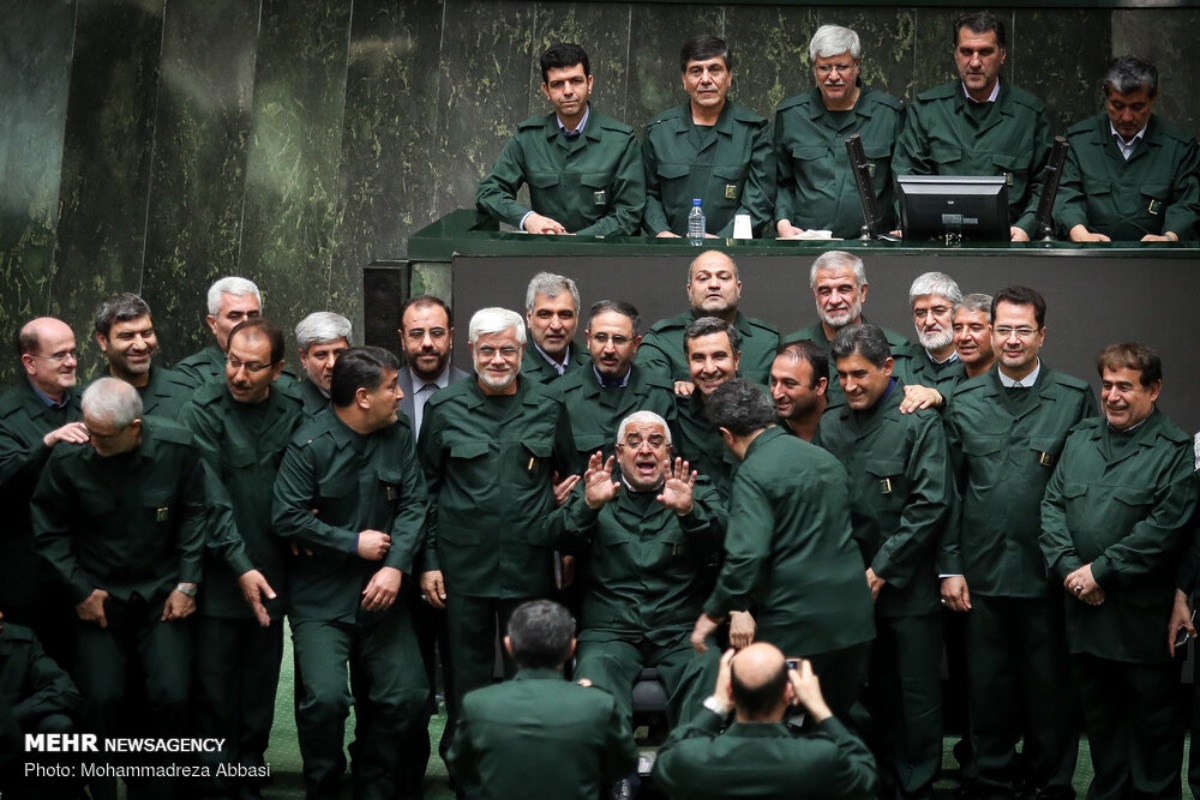
The deaths of Ali Khamenei and several senior military officials in the first US-Israeli strikes of 28 February 2026 could have brought about what “decapitation” strategies traditionally seek: the disorganisation of the chain of command, the inability to arbitrate between competing institutions and, in time, the paralysis of the regime. None of this happened.
Weakened, deprived of several of its guiding figures and faced with considerable destruction, the Islamic Republic nonetheless retained a remarkable capacity for coordination. The regime survived thanks to replacement mechanisms that made it possible to fill the main decision-making posts, sometimes three or four times in succession.
This resilience invites us to shift the question. The issue is no longer only whether the Islamic Republic will survive the passing of the generation that shaped it, but which Islamic Republic is in the process of succeeding it.
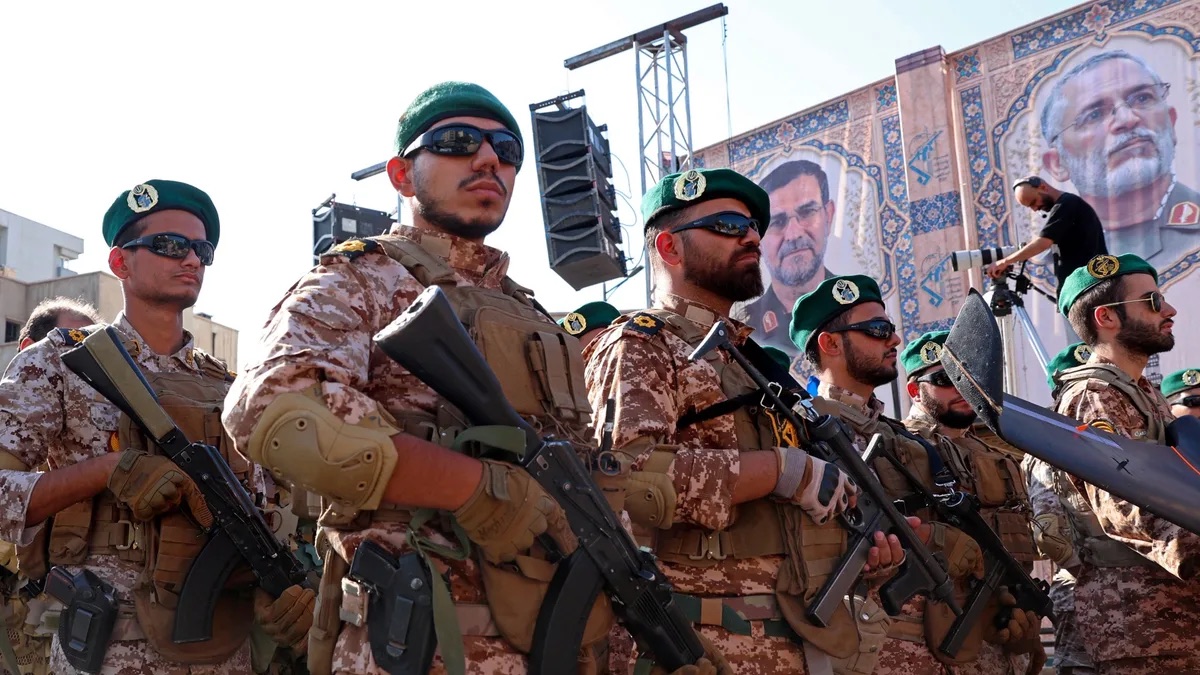
For several decades now, the Islamic Revolutionary Guard Corps, the “Sepāh-e Pāsdārān”, has no longer been simply an ideological army tasked with protecting the regime. As Hesam Forozan and Afshin Shahi point out in the Middle East Journal, the Pasdaran also run companies and organise economic networks that have spread throughout the Iranian economy, to the point that they are thought to control between 25 and 40% of GDP today according to the most conservative estimates.
It is, however, even more through their growing involvement in internal security, their penetration of ministries and provincial administrations, and the gradual integration of their former cadres into civilian institutions that the Pasdaran have become lastingly embedded in Iranian public life. The 2026 war did not reverse this dynamic in any way; on the contrary, it accelerated it, accentuating the militarisation of the regime and the weight of actors from the security apparatus within the structures of the state.
The phenomenon can be understood through the notion of “praetorianisation”: not an outright substitution of the military for the clergy, but a gradual shift in the effective exercise of power towards actors whose political socialisation took shape in war, intelligence, counter-insurgency and highly ideologised revolutionary apparatuses.
The Iran that results is not yet a junta, and certainly not a post-clerical state. It increasingly appears, however, as a “praetorian theocracy”: a regime in which religion remains an instrument of legitimation, while the military and security apparatuses become the main agents of its preservation, endowed with growing decision-making autonomy and an ever greater capacity to arbitrate between choices and to define strategic orientations.
I. The Islamic Republic’s security turn
Reducing this evolution to the upheavals of 2026 would be misleading. The trajectory of the Revolutionary Guard Corps is inseparable from the very formation of the Islamic Republic.
The Iran-Iraq war of 1980 to 1988 played a formative role in this respect. It transformed a still heterogeneous revolutionary organisation into a genuine military and bureaucratic apparatus, while giving rise to a generation whose solidarities, forged at the front, would long outlive the conflict.
Afshon Ostovar has shown how far the war helped to shape, at one and the same time, the political culture, militant religiosity and conception of power of the Pasdaran. The IRGC thus never became a professional army in the classic sense of the term: it remains an apparatus of war conceived as the guardian of a revolutionary order, in the only country in the world to have adopted a two-headed organisation of its armed forces.
Nor did the end of the conflict send the fighters back to their barracks. On the contrary, it opened the doors of the civilian economy to them. Created in the context of reconstruction, the Khatam al-Anbiya conglomerate gradually became one of the Guards’ main economic instruments. Public works, dams, oil and gas infrastructure, transport: the military apparatus thus acquired the material means to extend its influence far beyond the field of defence. The work of Forozan and Shahi documents this rise in economic power, which accelerated particularly under the governments of Mahmoud Ahmadinejad between 2005 and 2013.
This economic expansion was matched by a growing penetration of civilian institutions. Ministries, governorates, local administrations and security bodies took in an ever larger number of former Pasdaran. Under Ahmadinejad, several ministers came directly from the Corps; under Ebrahim Raisi, this logic continued. Ahmad Vahidi, Minister of the Interior between 2021 and 2024, notably oversaw a period marked by the appointment of many officials from the military and security structures to head provincial governorates.
The 2026 war therefore struck ground that had already been prepared. It nonetheless brutally upended the internal hierarchy of Iran’s military-security apparatus. The elimination of Ali Khamenei, after nearly thirty-seven years of largely uncontested power at the summit of the state, backed by considerable prerogatives under Article 110 of the Constitution, together with that of part of the senior political-military leadership, constitutes a major rupture, without for all that ushering in a new ruling class.
On the contrary, the war brought back to the heart of the decision-making apparatus figures whose careers are rooted in the founding period of the Islamic Republic: Ahmad Vahidi, Mohammad-Bagher Zolghadr and Mohsen Rezaei, but also Mohammad-Bagher Ghalibaf. Behind the turnover of posts, a remarkable sociological continuity thus appears: veterans of the Iran-Iraq war and cadres who emerged from the first counter-insurgency campaigns in Iranian Kurdistan, notably against the KDPI and Komala, continue to occupy a central place in the management of contemporary crises.
This phenomenon therefore calls for caution in handling the notion of “radicalisation”. The observable hardening, seen in the promotion of figures such as Ahmad Vahidi and Mohsen Rezaei to strategic posts, does not necessarily reflect the advent of a theologically more intransigent generation. It also results, and perhaps above all, from the shift of power’s centre of gravity towards an elite whose resources, careers and skills are essentially security-based.
II. After Khamenei: who really governs?
The succession to Ali Khamenei concentrates all the ambiguities of this new architecture of power.
His son Mojtaba Khamenei was designated Supreme Leader by the Assembly of Experts on 8 March 2026. Yet his designation amounts almost to an institutional paradox. Mojtaba possesses what his father did not possess in 1989: an intimate knowledge of the “Beyt-e Rahbari”, the Leader’s “house” or apparatus, as well as long-standing relations with the Guards. On the other hand, his religious, revolutionary and personal capital is markedly lower than that of Ali Khamenei.
According to several senior officials interviewed by Reuters, the Guards reportedly played a decisive role in his accession, overcoming the reluctance of part of the religious and political personnel. The agency even describes a succession imposed in circumstances contentious enough to have delayed its announcement.
The paradox is considerable: the institution that constitutionally derives its legitimacy from its obedience to the Leader now helps to shape the Leader on whom it depends.
This does not mean that Mojtaba Khamenei is devoid of power, still less that the “velāyat-e faqih” has ceased to organise the system legally. The relationship of dependence nonetheless seems to have changed. Whereas Ali Khamenei had decades of authority that allowed him to arbitrate between military officials, clerics, politicians and technocrats, his successor appears more embedded in the coalition that made his accession possible.
It is precisely here that the notion of a “post-clerical Iran” must be handled with caution. Post-clerical cannot mean post-religious. The IRGC itself is ideologically structured by the doctrine of the “velāyat-e faqih” (the authority of the jurist-theologian), while its cadres remain subject to mechanisms of religious and political supervision that depend on the Leader. Several specialists have moreover stressed that the hypothesis of an IRGC coup against the clergy overlooked this interpenetration: the military and the clerical system are less two foreign bodies than two progressively intertwined components of the same revolutionary order.
The current evolution thus seems less a matter of ousting the clergy than of a functional redistribution of roles. To the religious institutions falls mainly the production of constitutional and doctrinal legitimacy; to the military and security apparatuses, a growing place in the conduct of negotiations with adversaries, the definition of red lines and the organisation of military responses.
The career of Ahmad Vahidi is emblematic of this shift. Having passed through the IRGC’s intelligence structures, a former head of the Quds Force, Minister of Defence and then Minister of the Interior, Vahidi almost ideally embodies the type of actor produced by forty years of security cadres moving into civilian and territorial administrations. Since the war of February 2026, he has risen to commander-in-chief of the IRGC following the successive deaths of his predecessors. The Institute for the Study of War now ranks him among the main centres of power in the Iranian hierarchy reconstituted in Tehran.
Zolghadr offers a comparable trajectory. A former member of the clandestine anti-Shah Islamist group Mansourun, involved in organising external operations during the Iran-Iraq war through the Ramadan headquarters, and then for many years the IRGC’s number two, he was appointed head of the Supreme National Security Council after the death of Ali Larijani, a figure more associated with a pragmatic and technocratic profile.
In August 2026, Mohsen Rezaei succeeded him. A former commander-in-chief of the IRGC, which he led during most of the Iran-Iraq war, notably during the particularly bloody Karbala-4 offensive, he thus took the reins of the institution responsible for formulating strategic orientations in matters of national security and foreign policy.
The Larijani–Zolghadr–Rezaei succession on its own illustrates a significant change in the regime’s internal balance: a central function of political-strategic coordination is gradually passing into the hands of more ideologically marked veterans who come directly from the revolutionary military apparatus.
It would nevertheless be wrong to mechanically set a bellicose military camp against a civilian and diplomatic one.
Mohammad-Bagher Ghalibaf is probably the best illustration of this. A former commander of the IRGC air force, a former police chief and a war veteran, he unquestionably belongs to the world of the Guards. Yet in 2026 he became one of the main protagonists of the negotiations with Washington.
This positioning earned him attacks from the Paydari Front, Saeed Jalili and several ultraconservative figures. Demonstrations denounced Ghalibaf together with Foreign Minister Abbas Araghchi. This rift is not new, moreover: it extends long-standing tensions between Ghalibaf and the most intransigent principlist currents.
The fault line thus becomes more subtle. It no longer clearly separates the military from civilians, nor even “moderates” from “radicals”. Rather, it pits against each other several conceptions of how to preserve the regime: on one side, an ideological maximalism for which any concession threatens revolutionary identity; on the other, a security pragmatism that regards negotiation itself as an instrument of power.
This distinction helps explain why the militarisation of the state can simultaneously produce more coercion at home and greater tactical flexibility abroad.
The relative losers: the president and his ministers
This evolution necessarily alters the relative position of the other institutions.
The presidency retains a significant administrative capacity, but its strategic autonomy remains weak.
Masoud Pezeshkian provides a particularly clear illustration: an elected president and the interlocutor of foreign states, he remains under the constitutional tutelage of the Leader and must contend with security bodies capable of directly reducing his room for manoeuvre. When he apologised to the Gulf states after Iranian attacks, several security officials, including Vahidi, forced him to shift his position.
Electoral competition, whose legitimacy had already been weakened by high abstention rates, thus sees its political significance shrink. While figures such as Pezeshkian or Ghalibaf may still reflect certain balances of power within Iranian society, the continuity of the regime rests largely on a political-security apparatus whose main officials draw their authority not from the ballot box but from a revolutionary legitimacy claimed independently of any electoral endorsement.
Foreign policy itself does not escape this constraint. According to information reported by Iran International, the concessions that Abbas Araghchi is said to have considered regarding Tehran’s support for the “Axis of Resistance” reportedly aroused Zolghadr’s opposition and led, after consultations involving Hossein Taeb among others, to the breaking off of negotiations with Washington in Islamabad and the recall of the Iranian delegation to Tehran.
At the same time, the traditional clergy is also undergoing a relative marginalisation. It is by no means disappearing: the Assembly of Experts, the Guardian Council and the network of religious representatives remain constitutive of the system. But the clerics no longer necessarily seem to be the main managers of the crises the regime faces.
III. The hardening of the regime put to the test of compromise
The stiffening described above can therefore be reduced neither to a proliferation of bellicose rhetoric nor to a mere extension of military prerogatives. It shows itself above all in the growing integration of military, police, economic and diplomatic instruments within a single rationale of power.
The hardening of the regime therefore does not necessarily mean the rejection of compromise. Rather, it tends to redefine its terms, by making negotiation one of the possible extensions of coercion.
The Strait of Hormuz is the most obvious illustration of this. In October 2026, Iran no longer treats this space merely as a sea lane that can be closed in retaliation. Its control becomes an instrument of negotiation that is at once economic, military and political.
The Iranian authorities make the reopening of the passage conditional on a series of American concessions, while Mohsen Rezaei has emerged as one of the main spokesmen for this strategy and as a fervent defender of the seven conditions formalised during the Islamabad negotiations to allow the strait to reopen.
At the same time, the Guards are adapting their methods of maritime interdiction and stepping up the pressure on commercial shipping. Hormuz thus becomes less a mere military theatre than a point at which coercion is converted into negotiating capacity.
This logic also allows us to reread the memorandum concluded with the United States in June 2026. The fourteen-point interim agreement, which expired in August and had been weakened as early as July by the resumption of American strikes, provided in particular for a cessation of operations, the opening of a period of negotiations, the resumption of commercial shipping, provisions on oil sanctions and frozen Iranian assets, and a reconstruction mechanism valued at 300 billion dollars.
It nevertheless left several structural issues unresolved, foremost among them a lasting settlement of the nuclear question.
At first sight, the acceptance of such a compromise by a more militarised regime might seem to contradict the hypothesis of a hardening. Rather, it qualifies it. Negotiating does not necessarily mean calling into question ideological hostility towards Washington; it may, on the contrary, be a matter of identifying the moment when military instruments have produced a balance of power favourable enough to be converted into economic or strategic concessions.
Institutional hardening therefore does not seem to rule out compromise. Rather, it tends to make it a continuation of confrontation by other means. Missiles, control of Hormuz, sanctions, negotiations and ceasefires no longer necessarily belong to separate registers: they can be conceived as complementary components of a single strategy aimed at changing the status quo.
Conclusion
The recent trajectory of the Islamic Republic confirms less the emergence of a military regime than the deepening of its militarisation and securitisation. The growing weight of the Pasdaran, the spread of their cadres throughout the state apparatus and the increased centrality of the security organs are gradually shifting power’s centre of gravity towards the coercive institutions.